Artificial Intelligence: The Technology Redefining the Economy and Everyday Life
The rise of AI is transforming industries, labor markets, and the way people work and interact with technology.
Over the past few years, artificial intelligence (AI) has evolved from an experimental technology into one of the primary drivers of global digital transformation. Companies, governments, and universities are investing billions of dollars in its development, while its effects are increasingly being felt across the economy, the labor market, and the daily lives of millions of people.
International media outlets, including The New York Times, TIME, Nature, and The Washington Post, have highlighted that AI represents one of the most significant technological revolutions since the emergence of the internet.
A technological revolution comparable to the internet era
The impact of artificial intelligence extends across nearly every economic sector. AI-powered tools are being used to automate tasks, analyze large volumes of data, and accelerate innovation in areas such as medicine, education, e-commerce, and scientific research.
According to an analysis published by the scientific journal Nature, some economists estimate that artificial intelligence could add between $17 trillion and $26 trillion to the global economy in the coming decades, although other experts believe the impact could be more moderate depending on the pace of technological adoption.
At the same time, technology companies and governments are increasing their investments in AI infrastructure, such as data centers and supercomputers. These developments are creating new economic opportunities and technological hubs in different regions of the world.
Impact on employment and the labor market
One of the most important debates surrounding artificial intelligence concerns its impact on employment. Some experts warn that automation could replace certain types of jobs, particularly those involving repetitive tasks or information processing.
According to the Future of Jobs Report by the World Economic Forum, nearly 40% of employers are considering reducing their workforce in roles that can be automated using artificial intelligence, while at the same time new jobs related to the development, maintenance, and supervision of AI systems are expected to emerge.
Recent research also shows that AI does not necessarily eliminate jobs on a massive scale but rather transforms the skills required in the labor market. A study based on millions of job postings found that demand for skills complementary to artificial intelligence—such as critical thinking, teamwork, and digital literacy—is growing significantly.
However, some sectors may experience deeper transformations. Reports indicate that professions related to basic programming, customer support, and data processing are particularly vulnerable to automation.
New economic opportunities driven by AI
Despite concerns about employment, many economists believe that artificial intelligence could significantly boost economic growth.
A report cited by TIME magazine suggests that widespread adoption of AI could double productivity growth in the United States, which would have long-term positive effects on the economy.
In addition, new economic regions are emerging around the infrastructure required to operate AI systems. A recent article in The Washington Post describes how certain regions in the United States are attracting investments in data centers and technology companies, stimulating regional development and encouraging the creation of AI-driven startups.
Changes in everyday life
Beyond its economic impact, artificial intelligence is increasingly becoming part of everyday activities such as information search, customer service, medical assistance, and personalized education.
Tools based on generative AI models can write text, generate images, analyze complex datasets, and even assist in preliminary medical diagnostics. These capabilities are redefining how people interact with digital technologies.
However, experts also warn about the challenges associated with this transformation. These include the risk of misinformation generated by AI systems, concerns about data privacy, and the need for regulatory frameworks that ensure responsible and ethical use of these technologies.
A future still in development
The full impact of artificial intelligence is still unfolding. Some analysts warn that excessive enthusiasm in technology markets could create unrealistic expectations about the short-term profitability of AI investments.
Nevertheless, there is broad consensus among researchers and economists that AI will be one of the defining technologies of the 21st century.
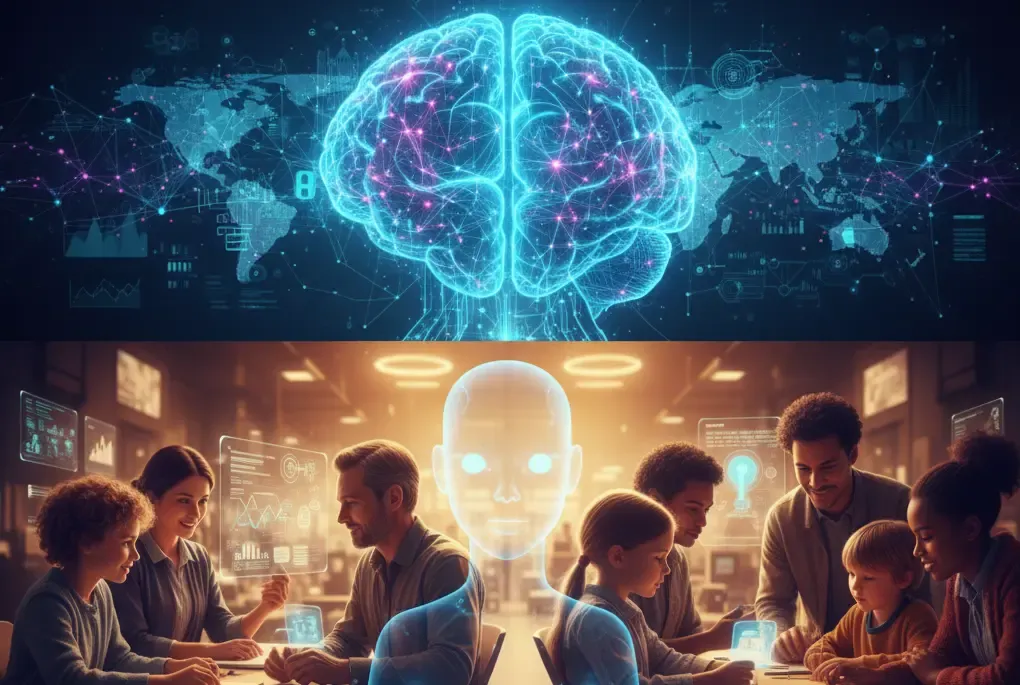
Rather than completely replacing humans, many experts believe the most likely scenario will involve collaboration between humans and intelligent systems, where machines amplify human capabilities rather than substitute them entirely.
References
- Nature – How AI is transforming the global economy
- World Economic Forum – Future of Jobs Report 2025
- TIME – AI and productivity growth
- The Washington Post – AI investments and regional economic transformation
- The New York Times – analysis on AI’s impact on work and the economy
- Goldman Sachs – Artificial Intelligence and the Future of Work
- Academic research from arXiv on AI’s impact on workforce skills